
17/12/2025
The Pulse of Society Beats on Social Media
You've either said or heard the phrase, "Everyone portrays their lives better than they are on social media," haven't you? Bright filters, vacation photos, perpetually smiling faces… Especially on Instagram, life always seems beautiful. But there's also a platform where emotions flow in their unfiltered, raw form, and tensions easily escalate: it is X, formerly Twitter.
Of course, not all content circulating on X is "real." But the words here don't just carry information; they also reveal anger, resentment, pleasure, and anxiety. Social media, especially X, can sometimes become a place for venting, and sometimes a collective spillover spot. In this respect, it offers an important window to observe the daily circulation of emotions.
It's not easy to know what society feels – especially when emotions fluctuate so rapidly. But if we can listen to emotions, we can better understand not only the mood of individuals but also that of society as a whole. This can be a very powerful guide for all institutions to take the right steps at the right time.
From Tweets to Social Mood
So, if this platform, where we share our joy, disappointment, and anger in a single sentence, could speak, what would it say about us? Or rather, is it possible to answer this question by analyzing the millions of messages collected on X?
A study stemming from this very question brings X's massive data pool to life. The article, co-authored by Assoc. Prof. Dr. Ezgi Akpınar from Sabancı University, Dr. Begüm Şener from Concordia University, and Assoc. Prof. Dr. Berk Ataman from Özyeğin University, and published in the journal Scientific Reports, reveals when, how often, and for how long 24 different emotions expressed on online social networks emerge, and how they transform over time. The title of the article is “Unveiling the dynamics of emotions in society through an analysis of online social network conversations.”
"If X, where we share our emotions in a single sentence, could speak, what would it say about us?"
Mapping Emotions from Millions of Tweets
Researchers analyzed over five million tweets collected from Türkiye over two years to determine which emotions people expressed, how frequently, how long those emotions lasted, and how they evolved over time. They used specially prepared emotion dictionaries, each broken down into its root words. This allowed them to tag tweets containing 24 different emotions, tracking which emotion was most prominent on which day. Additionally, to trace the underlying psychological structures of these emotions, they applied a nine-dimensional questionnaire including valence (positive/negative), arousal, and dominance (a psychological measure showing how strong and in control a person feels in the face of an emotion).
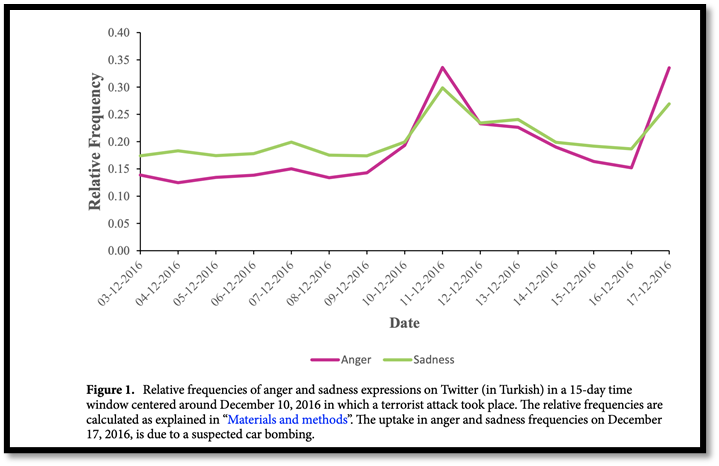
For example, as seen in the graph below, anger was prominent on social media immediately after the terrorist attack in front of the stadium in Beşiktaş, Istanbul. This anger was intensely felt in the first few days, but gradually decreased in the following days, giving way to a more complex mix of emotions. Over time, anger gives way to sadness, then that too gradually recedes, and the emotional tone of society returns to everyday levels.
The Rhythm of Emotions on Social Media
The research findings show that the most prominent emotions on online social networks are negative, dominant, and intense feelings. Emotions with high arousal and dominance, such as anger and frustration, are expressed more frequently in tweets. Conversely, positive but also highly aroused emotions—such as joy or enthusiasm—tend to remain prominent on social media for longer.
Another interesting finding is that dominant emotions like pride flare up and fade just as quickly. In contrast, less dominant but similarly valued emotions (such as peace or hope) tend to be more enduring.
Furthermore, when a particular emotion dominates social discourse, similar emotions fade into the background. However, in the long term—approximately a month later—emotions of similar value resurface.
“Negative, dominant emotions and intense feelings are most prominent on social networks.”
Conducting sound analysis in an environment where emotions are so volatile and fluid is challenging. That's precisely why this study offers valuable insights for decision-makers, communication professionals, and anyone working with the public. Which emotion rises when, which persists, and which suppresses others? This study, which seeks answers to all these questions through social media data, serves as a powerful guide to tracing the evolution of societal feelings over time.
Key findings:
- Emotions with negative valence but high dominance and/or arousal levels are more frequently observed in online social media conversations.
- The duration an emotion remains dominant on social networks generally increases depending on its valence (positivity) and arousal levels; conversely, this duration decreases as the dominance level increases.
- When an emotion becomes dominant on social media, it pushes other emotions with similar valence and dominance, and high arousal levels, into the background in the short term. However, in the longer term, such as about a month, emotions with similar valence tend to re-emerge.
Prepared by: Ceyda Sinağ
To read the full article:
Sener, B., Akpinar, E., & Ataman, M. B. (2023). Unveiling the dynamics of emotions in society through an analysis of online social network conversations. Scientific Reports, 13(1), 14997.
--
Link to the professors' biographies and other research:
Begüm Şener:
https://www.concordia.ca/faculty/begum-sener.html
https://scholar.google.com/citations?user=JAh7GAoAAAAJ&hl=tr&oi=sra
Ezgi Akpınar:
https://sbs.sabanciuniv.edu/tr/ezgi-akpinar-uysal
https://scholar.google.com/citations?user=TuxH1JgAAAAJ&hl=tr&oi=sra
Berk Ataman:
https://www.ozyegin.edu.tr/tr/akademik-kadro/berkataman
https://scholar.google.com/citations?user=ae2axagAAAAJ&hl=tr&oi=sra